


Merinos, Turkey’s carpet giant expanding into global markets, is counting down to its initial public offering
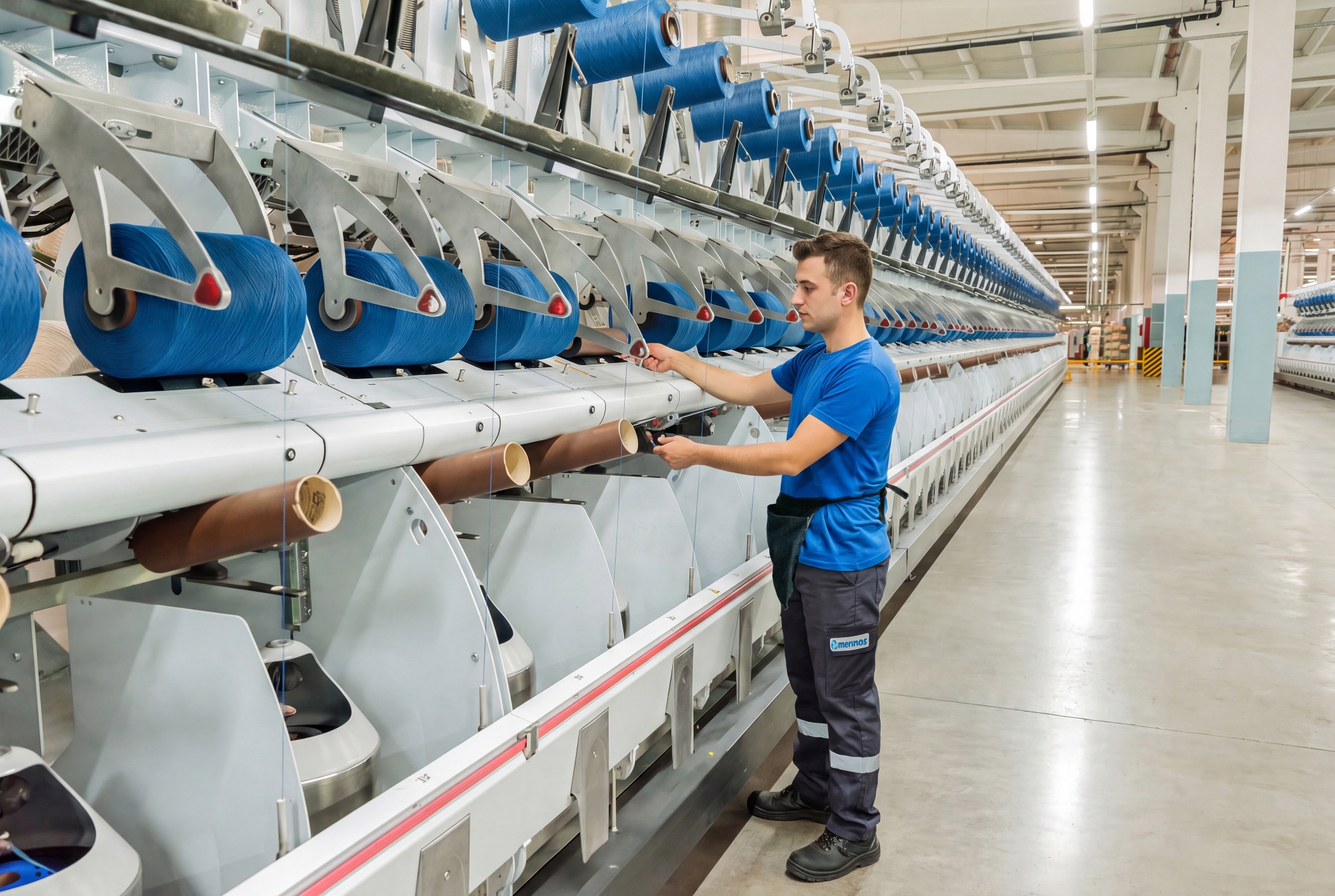
While touring the Merinos factory in Gaziantep with İbrahim Erdemoğlu and Mehmet Erdemoğlu, Chairman of the Board of Directors of Merinos, the first thing you see is, of course, carpets.
The production lines are running nonstop.
Meters of carpet roll off the machines, patterns change, colors change, and orders from different countries around the world are being prepared.
However, as our tour of the factory progressed and our conversation detailed, I realized that the real story to be told at Merinos today is not just about carpets.
The initial public offering.
The Erdemoğlu Group is preparing to take Merinos public.
Moreover, they view the planned operation as significant not only for Merinos but also for Turkey’s capital markets.
İbrahim Erdemoğlu explains as follows:
"We’re talking about an international initial public offering on a scale not seen since 2017. It will be a high-value offering."
According to the plan, more than 50 percent of the initial public offering allocation will be made to corporate investors abroad.
The "international nature" and the emphasis on 2017 in this statement are significant.
A NEW TEST FOLLOWING MAVİ AND ENERJİSA
When we look at the recent history of Turkey’s capital markets, two major initial public offerings with high interest from foreign institutional investors stand out.
One of these is Mavi Giyim.
Mavi went public in June 2017. Foreign corporate investors acquired approximately 74 percent of the shares offered. At the time, Mavi’s initial public offering was recorded as the largest in Turkey since 2013.
Another significant example is Enerjisa Enerji.
The company went public in February 2018. Twenty percent of its shares were offered in the initial public offering, making it the largest private-sector initial public offering in Turkey’s history in TL terms at the time. Total demand reached 4.8 times the number of shares offered.
Merinos is now aiming for a capital markets transaction of this scale, one in which international corporate investors are once again heavily involved.
For this reason, İbrahim Erdemoğlu does not view Merinos’s initial public offering merely as a financing operation for his own companies:
"In our view, when you consider the size of this initial public offering, its corporate nature, and the foreign capital it will bring to Turkey, this is not just about Merinos’s initial public offering."
HOW WILL MERINOS BE PRESENTED TO FOREIGN INVESTORS?
This is where one of the most interesting debates surrounding the initial public offering begins.
Which version of Merinos will foreign investors see?
A carpet company?
Or an industrial company that started with carpets and has expanded into raw materials, chemicals, and advanced integration?
Mehmet Erdemoğlu's answer is clear:
"“Merinos is not just a carpet company."
He uses an example from soccer to explain this.
He recalls the "More than a club" approach used by Barcelona, one of the world’s most famous soccer clubs, to describe itself:
"We, too, see Merinos as more than just a carpet company."
This is not just a slogan.
As you walk deeper into the factory, you see the economic logic behind it.
Merinos produces carpets.
But it also produces the yarn needed to make the carpets.
It produces the dye for the yarn.
It handles the dyeing process itself.
Now it’s taking the process one step further back in the supply chain.
A 270 MILLION DOLLARS INVESTMENT
Merinos has made an investment of approximately 270 million dollars in polyester chips.
According to the plan, it will begin producing polyester chips in-house starting October 1st.
This will further deepen the end-to-end integration in the production chain, extending from carpets to yarn, and from dye to polyester raw materials.
The financial impact of this strategy is also noteworthy.
According to figures provided by the Erdemoğlu management, the earnings before interest, taxes, and depreciation (EBITDA) margins of companies in this sector worldwide generally range between 10% and 12%.
At Merinos, however, this ratio is approximately 20 percent.
One of the key reasons for this difference is the company’s integrated production model.
And this difference is also one of the central issues in the initial public offering valuation.
WILL MERİNOS RECEIVE A "CARPET MANUFACTURER MULTIPLIER"?
During discussions with investment firms in the run-up to the initial public offering, one of the key points of debate was which companies Merinos should be compared to.
This is because the business multiples for traditional carpet and flooring companies are well-established.
Merinos management, however, argues that it would not be accurate to compare the company solely to these firms.
The rationale is integration.
Its production structure is increasingly intersecting with sectors such as chemicals, petrochemicals, and packaging.
According to İbrahim Erdemoğlu, the investment firms' approach also shifted as the discussions progressed:
"In the end, they too reached the point where they said, 'Yes, you’re right. We won’t compare you solely to carpet or flooring companies.'"
The plan is to include companies from the chemical, petrochemical, and packaging sectors in the valuation comparisons.
This is important.
Because valuation multiples in these sectors can start at higher levels than those for companies in the traditional carpet sector.
Therefore, the critical question regarding Merinos's initial public offering is not just how many billions of dollars the company will be valued at when it goes public.
It's in which sector the market will price Merinos.
A TENFOLD INCREASE EVERY 10 YEARS
So how did the company set to be presented to foreign investors reach this point?
The numbers tell an interesting growth story.
In 1983, annual revenue was approximately 250,000 dollars.
In 1993, it was 3 million dollars.
In 2003, it was 30 million dollars.
In 2013, it was 300 million dollars.
And in 2023, it reached 3 billion dollars.
In other words, Merinos and Erdemoğlu have increased their scale tenfold roughly every 10 years.
İbrahim Erdemoğlu says this is no coincidence:
"Merinos’s growth is not a coincidence; it is the result of a strategy we have been implementing for many years."
However, he does not claim that the math of the past will be repeated exactly in the coming period.
The economic difficulties experienced both in Turkey and around the world following the pandemic also affected investment schedules.
There were delays of approximately one and a half to two years in the investments at SASA.
The story behind one of these delays is truly extraordinary.
GIANT REACTOR FELL INTO THE OCEAN
One of the largest reactors produced for SASA fell into the ocean while being transported.
The reactor had to be rebuilt.
İbrahim Erdemoğlu explains that this incident alone caused a delay of about one and a half years.
When combined with other global challenges following the pandemic, the investment schedule was further delayed.
For this reason, Erdemoğlu notes that his companies' past growth pace of "10-fold growth in 10 years" may not be replicated exactly by 2031.
Nevertheless, İbrahim Erdemoğlu stands by his claim:
"I can say that we will be far above today’s level and current economic conditions."
A 36-YEAR-OLD FAMILY CONSTITUTION
So how does a 250,000 dollars business transform into an industrial group worth billions of dollars?
İbrahim Erdemoğlu summarizes the answer to this question in two points.
First is the unity and solidarity within the family.
Second is the family constitution they established in 1990.
The most important provision of this constitution is quite simple:
At least 90 percent of the companies’ total profits are reinvested.
The total amount that all family members can receive from the companies, including salaries, cannot exceed 10 percent of the profits.
One partner can receive 3 percent.
Another can receive 2 percent.
Yet another receives less.
But the total amount received by all partners combined cannot exceed the 10 percent limit.
İbrahim Erdemoğlu explains:
"Instead of setting aside the money we earned to buy a house, a car, or other such things, we reinvested it back into the business. We directed at least 90 percent of the profit toward reinvestment."
And this system is still in place today.
WHERE DID SASA’S MONEY COME FROM?
This point is crucial for understanding the Erdemoğlu Group’s current scale.
Today, the public largely associates the Erdemoğlu name with SASA.
The billion-dollar investments in Adana…
Petrochemicals…
Yumurtalık…
Massive facilities…
But when you trace the capital chain back, the path leads to Gaziantep, to Merinos.
Over the years, Merinos was transformed into not just a manufacturing company, but one that generated strong cash flow.
And it was the cash generated by Merinos that provided the financial strength for the SASA acquisition.
That is why İbrahim Erdemoğlu’s statement is significant:
"Today, everyone is looking at SASA, but the root of it all is Merinos."
The money earned from carpets was reinvested in industry.
Industry generated even more cash.
That cash was turned into new factories.
And ultimately, a capital chain stretching from Merinos to SASA emerged.
92 PERCENT OF MERINOS’ REVENUE COMES FROM EXPORTS
Another key feature of Merinos from the perspective of foreign investors is the geographic breakdown of its revenue.
Today, the company generates approximately 92 percent of its revenue from exports.
It sells to over 100 countries.
Merinos' annual machine-made carpet production capacity is approximately 80 million square meters.
According to figures provided by company management, Merinos alone accounts for approximately 7 percent of the world’s machine-made carpet production.
The world’s largest retail chains, particularly in the U.S. and Europe, are among Merinos’s customers.
They specifically emphasize that being a supplier to these customers is not solely about price.
Being able to produce in high volumes…
Maintaining consistent quality…
Being reliable…
And delivering the product on time.
These are the new competitive criteria in the global supply chain.
OVERSEAS ORDERS UP BY 50 PERCENT
Merinos’ latest order figures are also noteworthy.
When comparing the international orders received last August with the company’s current international orders on a per-square-meter basis, there is an increase of approximately 50 percent.
For this reason, the company is hiring new workers.
It is bringing its idle capacity back online.
It is expanding its capacity.
Mehmet Erdemoğlu views this situation as a kind of "safe haven" effect.
He believes that a portion of customers may have switched from other suppliers to Merinos.
İbrahim Erdemoğlu's approach to times of crisis, meanwhile, sums up the family business’s history:
"Times of crisis have always presented a growth opportunity for our family businesses. We have grown even more during every crisis."
TARGET: THE U.S., EUROPE, AND THE U.K.
The priority in the upcoming period's growth strategy is not merely to create new production capacity.
It is to expand market share in existing major markets.
Grow in the U.S…
Deepen our presence in Europe…
Increase market share in the U.K…
Strengthen visibility in the Middle East…
Creating new opportunities in Africa, particularly in Central and Southern Africa, is also among the goals.
However, Merinos management does not look solely at population or market size.
Payment systems, trade insurance, financial infrastructure, and predictability are also key criteria in country selection.
For this reason, markets with stronger financial infrastructure, such as Europe, the UK, and the U.S., retain their priority status.
FOREIGN FUNDS ARE FAMILIAR WITH ERDEMOĞLU THROUGH SASA
Merinos’s initial public offering has another significant advantage on the international front:
SASA’s history in the capital markets.
SASA has been publicly traded since 1996.
It has developed its relationships with international institutional investors, particularly following its acquisition by the Erdemoğlu Group.
The company conducts at least three roadshows a year.
In the U.S…
In Europe…
In the U.K…
It meets with investors in the Gulf countries.
For this reason, Merinos will not be presenting itself to foreign investors as a company owned by an industrialist family they have never heard of.
Mehmet Erdemoğlu says that a significant portion of the international investors they have met are already familiar with SASA in Adana and the investments the Erdemoğlu Group has made there.
This makes it easier to explain Merinos.
Another noteworthy detail concerns Gaziantep’s geographic location.
According to information provided by Mehmet Erdemoğlu, among the investors they have met with so far, no one has said:
"The region is unstable, the facility is in Gaziantep, so let’s not invest."
WHERE WILL THE INITIAL PUBLIC OFFERING PROCEEDS GO?
Let’s turn to one of the most important questions regarding the initial public offering.
Where will the money go?
According to information provided by company management, there are two main uses for the initial public offering proceeds.
The first is to finance existing investments and balance related obligations.
The second is to strengthen the capital structure of the group companies.
Consequently, the funds generated by the Merinos initial public offering are expected to strengthen the Erdemoğlu Group’s overall financial structure and, indirectly, contribute to lowering SASA’s leverage ratio.
The goal is to reduce SASA’s leverage ratio to approximately 4 by the end of 2026 and even lower by 2027.
For this reason, viewing the Merinos initial public offering solely through the lens of Merinos’s balance sheet would be incomplete.
The operation is part of the group’s broader financing strategy.
ARTIFICIAL INTELLIGENCE IS COMING TO CARPETS
One of the most intriguing aspects of the factory’s future lies in artificial intelligence.
Merinos has launched a strategic partnership with ZEKI - Center for Tangible AI and Digitalization at the Technical University of Berlin.
One of the first concrete applications is an AI-powered design assistant.
Thanks to this system, designers can reinterpret existing patterns in a matter of seconds.
Different patterns and designs can be created in collaboration with the customer.
Merinos management views artificial intelligence not as a replacement for human creativity, but as a technology that enhances it.
The long-term goal is even more ambitious:
Smart carpets.
By combining artificial intelligence, next-generation materials, and digital technologies, the aim is to take the carpet beyond its traditional uses.
I WENT INTO THE FACTORY THINKING IT WAS ABOUT CARPETS…
When you walk into the Merinos factory, you naturally look for carpets.
But as you walk out, a different picture forms in your mind.
250,000 dollars in revenue in 1983…
3 million dollars in 1993…
30 million dollars in 2003…
300 million dollars in 2013…
3 billion dollars in 2023…
A 36-year-old family tradition of reinvesting at least 90 percent of profits…
Merinos, which generated the cash to acquire SASA…
92 percent exports…
Over 100 countries…
80 million square meters of production capacity…
Approximately 7 percent of global machine-made carpet production…
An EBITDA margin of approximately 20 percent, compared to the industry average of 10–12 percent…
Now, a major initial public offering aimed at allocating more than 50 percent of the offering to foreign institutional investors…
The phrase "More than just a carpet company," coined by İbrahim Erdemoğlu as in Barcelona, takes on even greater meaning as it leaves the factory.
Because the story to be told to investors in Merinos’ initial public offering is not just about carpets.
It’s a half-century-old industrial model that began with carpets in Gaziantep and has expanded to SASA, petrochemicals, artificial intelligence, and global capital markets.
Source: Patronlar Dünyası
The production lines are running nonstop.
Meters of carpet roll off the machines, patterns change, colors change, and orders from different countries around the world are being prepared.
However, as our tour of the factory progressed and our conversation detailed, I realized that the real story to be told at Merinos today is not just about carpets.
The initial public offering.
The Erdemoğlu Group is preparing to take Merinos public.
Moreover, they view the planned operation as significant not only for Merinos but also for Turkey’s capital markets.
İbrahim Erdemoğlu explains as follows:
"We’re talking about an international initial public offering on a scale not seen since 2017. It will be a high-value offering."
According to the plan, more than 50 percent of the initial public offering allocation will be made to corporate investors abroad.
The "international nature" and the emphasis on 2017 in this statement are significant.
A NEW TEST FOLLOWING MAVİ AND ENERJİSA
When we look at the recent history of Turkey’s capital markets, two major initial public offerings with high interest from foreign institutional investors stand out.
One of these is Mavi Giyim.
Mavi went public in June 2017. Foreign corporate investors acquired approximately 74 percent of the shares offered. At the time, Mavi’s initial public offering was recorded as the largest in Turkey since 2013.
Another significant example is Enerjisa Enerji.
The company went public in February 2018. Twenty percent of its shares were offered in the initial public offering, making it the largest private-sector initial public offering in Turkey’s history in TL terms at the time. Total demand reached 4.8 times the number of shares offered.
Merinos is now aiming for a capital markets transaction of this scale, one in which international corporate investors are once again heavily involved.
For this reason, İbrahim Erdemoğlu does not view Merinos’s initial public offering merely as a financing operation for his own companies:
"In our view, when you consider the size of this initial public offering, its corporate nature, and the foreign capital it will bring to Turkey, this is not just about Merinos’s initial public offering."
HOW WILL MERINOS BE PRESENTED TO FOREIGN INVESTORS?
This is where one of the most interesting debates surrounding the initial public offering begins.
Which version of Merinos will foreign investors see?
A carpet company?
Or an industrial company that started with carpets and has expanded into raw materials, chemicals, and advanced integration?
Mehmet Erdemoğlu's answer is clear:
"“Merinos is not just a carpet company."
He uses an example from soccer to explain this.
He recalls the "More than a club" approach used by Barcelona, one of the world’s most famous soccer clubs, to describe itself:
"We, too, see Merinos as more than just a carpet company."
This is not just a slogan.
As you walk deeper into the factory, you see the economic logic behind it.
Merinos produces carpets.
But it also produces the yarn needed to make the carpets.
It produces the dye for the yarn.
It handles the dyeing process itself.
Now it’s taking the process one step further back in the supply chain.
A 270 MILLION DOLLARS INVESTMENT
Merinos has made an investment of approximately 270 million dollars in polyester chips.
According to the plan, it will begin producing polyester chips in-house starting October 1st.
This will further deepen the end-to-end integration in the production chain, extending from carpets to yarn, and from dye to polyester raw materials.
The financial impact of this strategy is also noteworthy.
According to figures provided by the Erdemoğlu management, the earnings before interest, taxes, and depreciation (EBITDA) margins of companies in this sector worldwide generally range between 10% and 12%.
At Merinos, however, this ratio is approximately 20 percent.
One of the key reasons for this difference is the company’s integrated production model.
And this difference is also one of the central issues in the initial public offering valuation.
WILL MERİNOS RECEIVE A "CARPET MANUFACTURER MULTIPLIER"?
During discussions with investment firms in the run-up to the initial public offering, one of the key points of debate was which companies Merinos should be compared to.
This is because the business multiples for traditional carpet and flooring companies are well-established.
Merinos management, however, argues that it would not be accurate to compare the company solely to these firms.
The rationale is integration.
Its production structure is increasingly intersecting with sectors such as chemicals, petrochemicals, and packaging.
According to İbrahim Erdemoğlu, the investment firms' approach also shifted as the discussions progressed:
"In the end, they too reached the point where they said, 'Yes, you’re right. We won’t compare you solely to carpet or flooring companies.'"
The plan is to include companies from the chemical, petrochemical, and packaging sectors in the valuation comparisons.
This is important.
Because valuation multiples in these sectors can start at higher levels than those for companies in the traditional carpet sector.
Therefore, the critical question regarding Merinos's initial public offering is not just how many billions of dollars the company will be valued at when it goes public.
It's in which sector the market will price Merinos.
A TENFOLD INCREASE EVERY 10 YEARS
So how did the company set to be presented to foreign investors reach this point?
The numbers tell an interesting growth story.
In 1983, annual revenue was approximately 250,000 dollars.
In 1993, it was 3 million dollars.
In 2003, it was 30 million dollars.
In 2013, it was 300 million dollars.
And in 2023, it reached 3 billion dollars.
In other words, Merinos and Erdemoğlu have increased their scale tenfold roughly every 10 years.
İbrahim Erdemoğlu says this is no coincidence:
"Merinos’s growth is not a coincidence; it is the result of a strategy we have been implementing for many years."
However, he does not claim that the math of the past will be repeated exactly in the coming period.
The economic difficulties experienced both in Turkey and around the world following the pandemic also affected investment schedules.
There were delays of approximately one and a half to two years in the investments at SASA.
The story behind one of these delays is truly extraordinary.
GIANT REACTOR FELL INTO THE OCEAN
One of the largest reactors produced for SASA fell into the ocean while being transported.
The reactor had to be rebuilt.
İbrahim Erdemoğlu explains that this incident alone caused a delay of about one and a half years.
When combined with other global challenges following the pandemic, the investment schedule was further delayed.
For this reason, Erdemoğlu notes that his companies' past growth pace of "10-fold growth in 10 years" may not be replicated exactly by 2031.
Nevertheless, İbrahim Erdemoğlu stands by his claim:
"I can say that we will be far above today’s level and current economic conditions."
A 36-YEAR-OLD FAMILY CONSTITUTION
So how does a 250,000 dollars business transform into an industrial group worth billions of dollars?
İbrahim Erdemoğlu summarizes the answer to this question in two points.
First is the unity and solidarity within the family.
Second is the family constitution they established in 1990.
The most important provision of this constitution is quite simple:
At least 90 percent of the companies’ total profits are reinvested.
The total amount that all family members can receive from the companies, including salaries, cannot exceed 10 percent of the profits.
One partner can receive 3 percent.
Another can receive 2 percent.
Yet another receives less.
But the total amount received by all partners combined cannot exceed the 10 percent limit.
İbrahim Erdemoğlu explains:
"Instead of setting aside the money we earned to buy a house, a car, or other such things, we reinvested it back into the business. We directed at least 90 percent of the profit toward reinvestment."
And this system is still in place today.
WHERE DID SASA’S MONEY COME FROM?
This point is crucial for understanding the Erdemoğlu Group’s current scale.
Today, the public largely associates the Erdemoğlu name with SASA.
The billion-dollar investments in Adana…
Petrochemicals…
Yumurtalık…
Massive facilities…
But when you trace the capital chain back, the path leads to Gaziantep, to Merinos.
Over the years, Merinos was transformed into not just a manufacturing company, but one that generated strong cash flow.
And it was the cash generated by Merinos that provided the financial strength for the SASA acquisition.
That is why İbrahim Erdemoğlu’s statement is significant:
"Today, everyone is looking at SASA, but the root of it all is Merinos."
The money earned from carpets was reinvested in industry.
Industry generated even more cash.
That cash was turned into new factories.
And ultimately, a capital chain stretching from Merinos to SASA emerged.
92 PERCENT OF MERINOS’ REVENUE COMES FROM EXPORTS
Another key feature of Merinos from the perspective of foreign investors is the geographic breakdown of its revenue.
Today, the company generates approximately 92 percent of its revenue from exports.
It sells to over 100 countries.
Merinos' annual machine-made carpet production capacity is approximately 80 million square meters.
According to figures provided by company management, Merinos alone accounts for approximately 7 percent of the world’s machine-made carpet production.
The world’s largest retail chains, particularly in the U.S. and Europe, are among Merinos’s customers.
They specifically emphasize that being a supplier to these customers is not solely about price.
Being able to produce in high volumes…
Maintaining consistent quality…
Being reliable…
And delivering the product on time.
These are the new competitive criteria in the global supply chain.
OVERSEAS ORDERS UP BY 50 PERCENT
Merinos’ latest order figures are also noteworthy.
When comparing the international orders received last August with the company’s current international orders on a per-square-meter basis, there is an increase of approximately 50 percent.
For this reason, the company is hiring new workers.
It is bringing its idle capacity back online.
It is expanding its capacity.
Mehmet Erdemoğlu views this situation as a kind of "safe haven" effect.
He believes that a portion of customers may have switched from other suppliers to Merinos.
İbrahim Erdemoğlu's approach to times of crisis, meanwhile, sums up the family business’s history:
"Times of crisis have always presented a growth opportunity for our family businesses. We have grown even more during every crisis."
TARGET: THE U.S., EUROPE, AND THE U.K.
The priority in the upcoming period's growth strategy is not merely to create new production capacity.
It is to expand market share in existing major markets.
Grow in the U.S…
Deepen our presence in Europe…
Increase market share in the U.K…
Strengthen visibility in the Middle East…
Creating new opportunities in Africa, particularly in Central and Southern Africa, is also among the goals.
However, Merinos management does not look solely at population or market size.
Payment systems, trade insurance, financial infrastructure, and predictability are also key criteria in country selection.
For this reason, markets with stronger financial infrastructure, such as Europe, the UK, and the U.S., retain their priority status.
FOREIGN FUNDS ARE FAMILIAR WITH ERDEMOĞLU THROUGH SASA
Merinos’s initial public offering has another significant advantage on the international front:
SASA’s history in the capital markets.
SASA has been publicly traded since 1996.
It has developed its relationships with international institutional investors, particularly following its acquisition by the Erdemoğlu Group.
The company conducts at least three roadshows a year.
In the U.S…
In Europe…
In the U.K…
It meets with investors in the Gulf countries.
For this reason, Merinos will not be presenting itself to foreign investors as a company owned by an industrialist family they have never heard of.
Mehmet Erdemoğlu says that a significant portion of the international investors they have met are already familiar with SASA in Adana and the investments the Erdemoğlu Group has made there.
This makes it easier to explain Merinos.
Another noteworthy detail concerns Gaziantep’s geographic location.
According to information provided by Mehmet Erdemoğlu, among the investors they have met with so far, no one has said:
"The region is unstable, the facility is in Gaziantep, so let’s not invest."
WHERE WILL THE INITIAL PUBLIC OFFERING PROCEEDS GO?
Let’s turn to one of the most important questions regarding the initial public offering.
Where will the money go?
According to information provided by company management, there are two main uses for the initial public offering proceeds.
The first is to finance existing investments and balance related obligations.
The second is to strengthen the capital structure of the group companies.
Consequently, the funds generated by the Merinos initial public offering are expected to strengthen the Erdemoğlu Group’s overall financial structure and, indirectly, contribute to lowering SASA’s leverage ratio.
The goal is to reduce SASA’s leverage ratio to approximately 4 by the end of 2026 and even lower by 2027.
For this reason, viewing the Merinos initial public offering solely through the lens of Merinos’s balance sheet would be incomplete.
The operation is part of the group’s broader financing strategy.
ARTIFICIAL INTELLIGENCE IS COMING TO CARPETS
One of the most intriguing aspects of the factory’s future lies in artificial intelligence.
Merinos has launched a strategic partnership with ZEKI - Center for Tangible AI and Digitalization at the Technical University of Berlin.
One of the first concrete applications is an AI-powered design assistant.
Thanks to this system, designers can reinterpret existing patterns in a matter of seconds.
Different patterns and designs can be created in collaboration with the customer.
Merinos management views artificial intelligence not as a replacement for human creativity, but as a technology that enhances it.
The long-term goal is even more ambitious:
Smart carpets.
By combining artificial intelligence, next-generation materials, and digital technologies, the aim is to take the carpet beyond its traditional uses.
I WENT INTO THE FACTORY THINKING IT WAS ABOUT CARPETS…
When you walk into the Merinos factory, you naturally look for carpets.
But as you walk out, a different picture forms in your mind.
250,000 dollars in revenue in 1983…
3 million dollars in 1993…
30 million dollars in 2003…
300 million dollars in 2013…
3 billion dollars in 2023…
A 36-year-old family tradition of reinvesting at least 90 percent of profits…
Merinos, which generated the cash to acquire SASA…
92 percent exports…
Over 100 countries…
80 million square meters of production capacity…
Approximately 7 percent of global machine-made carpet production…
An EBITDA margin of approximately 20 percent, compared to the industry average of 10–12 percent…
Now, a major initial public offering aimed at allocating more than 50 percent of the offering to foreign institutional investors…
The phrase "More than just a carpet company," coined by İbrahim Erdemoğlu as in Barcelona, takes on even greater meaning as it leaves the factory.
Because the story to be told to investors in Merinos’ initial public offering is not just about carpets.
It’s a half-century-old industrial model that began with carpets in Gaziantep and has expanded to SASA, petrochemicals, artificial intelligence, and global capital markets.
Source: Patronlar Dünyası